Terrazzo Outdoor Floor Tiles and Tips for Choosing the Right Design for Outdoor Projects
Outdoor areas face some of the harshest conditions: intense sunlight, prolonged rain, thermal shock, and continuous friction and loading. Unlike industrial glazed tiles, which can crack or become overly glossy, precast terrazzo floor tiles are increasingly preferred by architects for their natural stone-chip appearance and high density. However, choosing outdoor flooring should never be based solely on an attractive showroom sample while overlooking real-world technical requirements.

Terrazzo outdoor floor tiles with a matte, slip-resistant surface that harmonizes with the natural landscape
Why Are Terrazzo Floor Tiles Suitable for Outdoor Spaces?
The nature of precast terrazzo tiles is a dense mineral aggregate concrete body combined with natural stone chips and compacted under high static pressure, providing three key advantages for outdoor applications:
-
Thermal expansion compatibility with the substrate: Non-fired, hydraulically pressed cement-based aggregate has thermal expansion characteristics compatible with the concrete base, helping reduce the risk of blistering or joint separation during sudden changes between sun and rain.
-
Long-lasting mineral coloration: Tile colors are formed from marble chips, natural quartz, and mineral pigments integrated 6–8 mm into the tile body, helping prevent surface fading or peeling.
-
Natural texture that complements the landscape: The random distribution of stone chips creates tactile depth and blends naturally with greenery, water features, and pebbles.
See also: Viettiles Terrazzo Tiles – Artistic Tiles for Garden Spaces
Choosing Terrazzo Outdoor Tiles Should Not Start with the Most Attractive Sample
A large-chip, multicolored Macro chip tile may look impressive when held in a showroom, but when installed across an 80 m² outdoor area exposed to intense sunlight, it can turn the entire surface into a visually chaotic pattern that overwhelms the architecture of the house.
A technically sound selection process should always follow this order: Slip Resistance → Actual Load → Color Tone Under Natural Light → Stone Chip Size.
5 Criteria to Check Before Choosing Terrazzo Tiles for Outdoor Areas
1. Slip Resistance
Never use a Polished surface outdoors. Exterior areas should use Honed, Sandblasted, or bush-hammered/textured surfaces to create sufficient friction when wet.
2. Thickness According to Load
Standard pedestrian areas generally require tiles 20–25 mm thick. Driveways or sloped vehicle-access areas require tiles at least 30 mm thick installed over a load-bearing concrete substrate.
3. Two-Layer Penetrating Sealer Treatment
A Penetrating Sealer should be applied to close the capillaries, reduce the penetration of dirty water and staining agents, and help prevent moss and mold from developing through the underside of the tiles.
4. Thickness of the Exposed Stone-Chip Surface Layer
The stone-chip and mineral-pigment surface layer should be at least 6–8 mm thick to allow for maintenance grinding and refinishing after 5–10 years of use.

Close-up of the substantial natural stone-chip surface of premium terrazzo outdoor floor tiles
Choosing Terrazzo Tile Designs According to Outdoor Area and Style
| Outdoor Area | Aggregate Grading & Size | Color Tone | Style |
|---|---|---|---|
| Small area (<25 m²) | 30×30 cm; fine chips (Micro: 2–5 mm) | Light gray, beige, gray-white | Minimalist, Modern |
| Medium area (25–60 m²) | 40×40, 60×60 cm; medium chips (Midi: 5–10 mm) | Cement gray, burnt sand | Tropical, Rustic |
| Large area (>60 m²) | 60×60 cm; large chips (Macro: 15–25 mm) | Dark gray, charcoal, terracotta | Resort Villas, Contemporary |
Explore specialized precast terrazzo tiles for landscaping at Viettiles: View the Terrazzo Collection
How Does a Terrazzo Tile Design Change When Installed Across a Large Area?
-
Brightness can increase by 20%–30% under direct sunlight: Sunlight reflection makes light colors appear significantly brighter outdoors than indoors. Consider choosing a slightly darker tone when reviewing the actual sample.
-
Chip density is visually multiplied across large areas: Excessively dense stone chips can make a large floor look visually busy. Without transitional or zoning areas, prioritize single-tone or low-contrast chip designs.
-
Grout joints define the composition: If the grout color contrasts too strongly with the tile, the entire outdoor floor can become visually fragmented into rigid checkerboard-like sections.
Common Mistakes When Choosing Terrazzo Outdoor Floor Tiles
-
Using interior tiles outdoors: Smooth, glossy surfaces can become slippery during rainy weather and quickly develop scratches from sand and gravel abrasion.
-
Failing to provide adequate drainage slope: Outdoor surfaces should have a slope of approximately 1.5%–2% toward drainage points to prevent prolonged standing water.
-
Ignoring movement joints: For areas larger than 20 m², omitting flexible movement joints can cause edge pressure, tile lifting, or joint cracking when summer temperatures rise.
-
Using strong acid-based cleaning chemicals: Acids can react with calcium-based components in cement and marble, causing surface erosion and staining.
Where Can Terrazzo Tiles Be Used Outdoors?
1. Front Yards and Vehicle Ramps
These areas experience high loads and continuous tire friction. A honed or sandblasted surface combined with charcoal-gray tones can help conceal tire marks while providing better slip resistance.
2. Verandas and Outdoor Transitional Entrances
They create a smooth material transition between interior wood flooring and the surrounding garden landscape.
3. Garden Paths and Stepping Stones Across Lawns
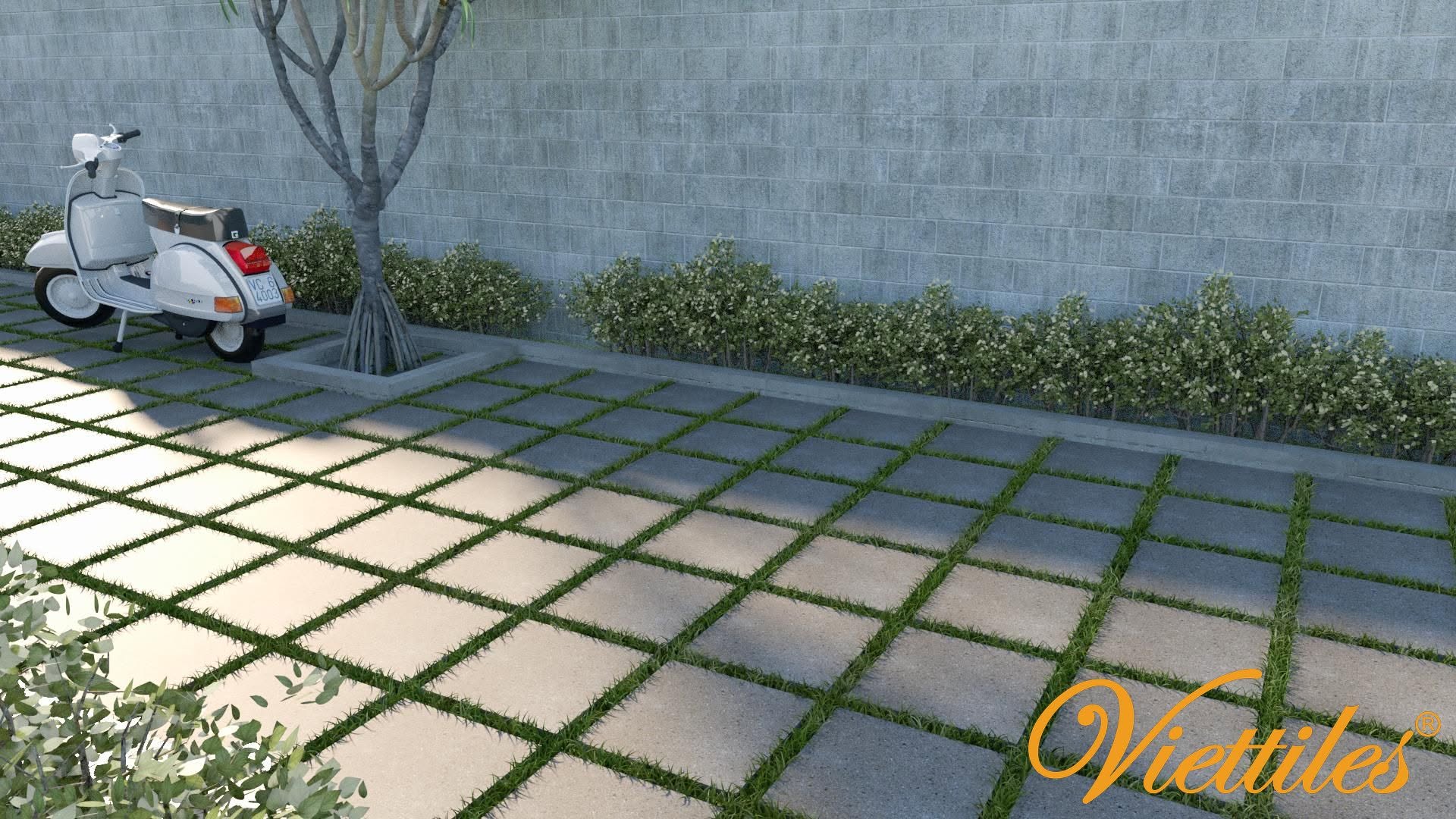
Large-format terrazzo stepping tiles installed over gravel or lawns create clean, elegant walkways without disrupting the natural greenery.
4. Pool Surrounds
Deeply textured surfaces, such as sandblasted or bush-hammered finishes, provide improved slip resistance for barefoot movement on surfaces that are frequently wet.

Terrazzo stepping tiles combined with pebbles create an elegant and clean garden pathway
Where Should You Start When Choosing Terrazzo Tiles for a Project?
Do not approve a design based solely on a 3D image displayed on a screen. A technically appropriate selection process should follow these steps:
-
Accurately determine the actual load requirements and the direction of sunlight and rainfall across the outdoor area.
-
Ask the manufacturer to provide physical samples with an exterior-grade textured finish so they can be tested directly under sunlight and when wet.
-
Choose a reputable manufacturer with high-pressure static pressing technology to ensure dimensional accuracy and consistency between production batches.
At Viettiles, precast terrazzo collections for outdoor applications are manufactured using high-pressure static pressing technology across a system of three factories in Ho Chi Minh City, with a production capacity of approximately 60,000 m² per month. Using natural marble aggregates, high-quality mineral pigments, and an environmentally friendly non-fired production process, Viettiles terrazzo tiles combine mechanical durability, outdoor-grade slip resistance, and a natural mineral aesthetic designed to endure over time.
Frequently Asked Technical Questions (FAQ)
1. Are terrazzo outdoor tiles slippery during the rainy season?
Not if the appropriate exterior surface is selected, such as Honed, sandblasted, or textured finishes. Polished finishes should not be used outdoors because they are primarily intended for interior flooring.
2. Can terrazzo outdoor tiles withstand a seven-seat car or pickup truck?
Yes, provided that the tile thickness is appropriate (30 mm or more [NEEDS CONFIRMATION]) and the underlying load-bearing concrete substrate is properly constructed without hollow areas beneath the adhesive.
3. How can outdoor terrazzo flooring be protected from moss and mold?
Two factors are important: provide a 1.5%–2% drainage slope to prevent standing water and apply two coats of a specialized Penetrating Sealer periodically to reduce water absorption through the cement capillaries.
Technical Consultation & Sample Supply
VIETTILES
Office & Showroom: No. 17, Street 40, An Khanh Ward, Thu Duc City (formerly District 2), Ho Chi Minh City
Hotline: +84 906 830 362
Email: info@viettiles.com
Website: www.viettiles.com